
What is proposed
Superior Hotels of Trinidad and Tobago Ltd has applied for approval to construct a large-scale tourism and residential development on 12 hectares at Rocky Point, Tobago. The project includes a 200-room hotel, bungalows, villas, private residences, resort amenities, internal roads, and supporting infrastructure.
📧 Note: comments must be submitted to corpsec@ema.co.tt
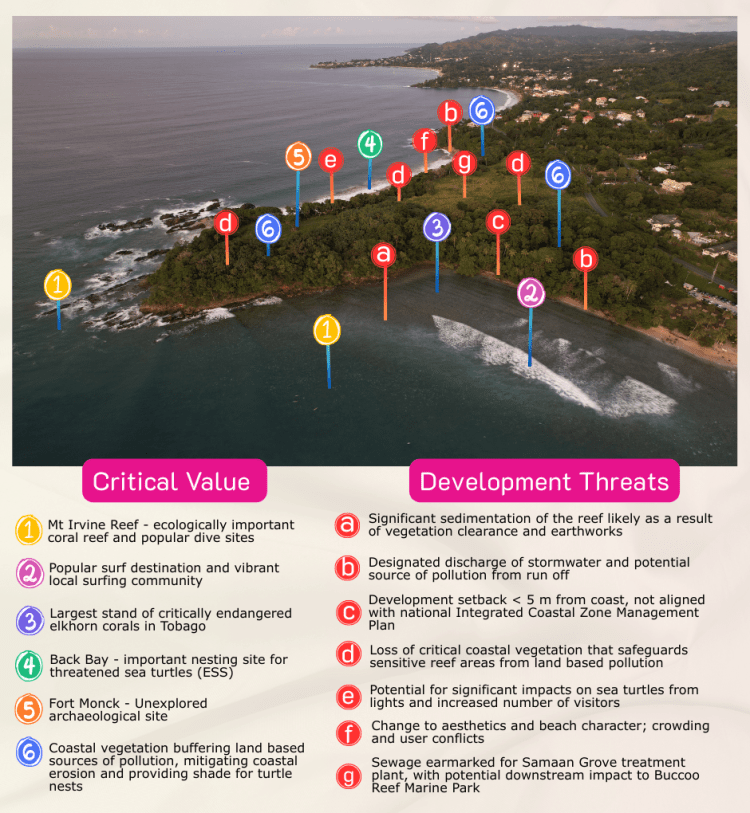
Why Rocky Point Matters: Critical Values
1. Mt Irvine fringing coral reef
The Mt Irvine fringing reef extends from the Mt Irvine beach bar along the lee of Rocky Point. It is one of the few remaining reefs in southwest Tobago with high live coral abundance and diversity, supporting a wide range of marine life, including resident juvenile hawksbill and green sea turtles. The reef contains 13 critically endangered coral species, including rare elkhorn corals found in shallow water only metres from the shore.
The reef protects the coastline, creates the well-known surf break, and supports local fisheries. Its health – comparable to that of Buccoo Reef Marine Park – is largely due to the intact vegetation at Rocky Point, which helps limit land-based pollution.
However, Mt Irvine Reef faces increasing threats. It experienced severe bleaching in 2023 and 2024 and remains at risk of disease outbreaks such as stony coral tissue loss disease (SCTLD). Chronic pressures from pollution and fishing continue to affect natural recovery and highlight the need for stronger marine management.
The reef is a popular diving and snorkelling site and is known for coral spawning. Because it is not strongly connected to nearby reefs and relies heavily on self-seeding, significant coral loss would severely limit natural regeneration.
2. Popular surf destination
Mt Irvine Bay at Rocky Point is one of Tobago’s premier surfing spots, attracting both local and international surfers. The natural reef break provides consistent waves, supporting a vibrant surf community and contributing to tourism.
Surfing sustains surf schools, equipment rentals, and beachside vendors, making the activity culturally and economically important. Any change to the reef structure, water quality, or coastal stability could directly affect wave conditions and the livelihoods that depend on them.
3. Largest stand of critically endangered elkhorn corals in Tobago
The Mt Irvine fringing reef at Rocky Point hosts the largest known stand of critically endangered elkhorn corals in Tobago. Located in water 0–3 metres deep, these corals support marine biodiversity by providing habitat for numerous species.
Elkhorn corals also help protect coastlines from erosion and sustain reef systems that support local fisheries and recreational activities such as snorkelling and diving. Preserving this unique coral stand is essential for the resilience of Tobago’s coastal ecosystems.
4. Back Bay – Important nesting site for threatened sea turtles (ESS)
Back Bay is one of Tobago’s most important nesting beaches for leatherback and hawksbill turtles. Despite its small size, it hosts a high density of nests each year. Its undeveloped nature provides a rare refuge, free from artificial lighting and beach structures.
The intact vegetation protects the coast from erosion and offers shade that helps regulate sand temperatures – crucial for hatchling success. Leatherbacks and hawksbills are globally threatened and recognised as Environmentally Sensitive Species (ESS) in Trinidad and Tobago (T&T), making Back Bay’s protection essential.
Trinidad and Tobago is a Party to the Specially Protected Areas and Wildlife (SPAW)
Protocol. Under the Protocol, elkhorn corals, mountainous star corals, and all species of sea turtles are listed under Annex II (endangered and threatened species). T&T must regulate or prohibit activities having adverse effects on such species or their habitats, and take measures to ensure these species’ total protection and recovery.
Many species of corals are also found under Annex III: Species for Management and Sustainable Use. Parties must ensure the populations are maintained at an optimal sustainable level.
5. Fort Monck – Unexplored archaeological site
Rocky Point contains the remains of Fort Monck and evidence of Indigenous occupation, offering insight into Tobago’s early history. Preserving this site is essential to protect its cultural and archaeological significance for future generations.
6. Coastal vegetation buffering land-based sources of pollution, mitigating coastal erosion and providing shade for turtle nests
Rocky Point’s coastal vegetation plays a vital role in protecting both land and sea. It filters runoff, reduces land-based pollution, stabilises soils, and mitigates coastal erosion. For sea turtles, this vegetation provides essential shade for nests, helping regulate sand temperatures in the face of rising heat driven by climate change. These natural defences are critical to maintaining Rocky Point’s ecological integrity.
Development Threats according to the Environmental Impact Assessment (EIA)
a. Sedimentation
Clearing vegetation and conducting earthworks on a sloping site increases the risk of sediment washing onto the Mt Irvine Reef during rainfall. The reef is already stressed from bleaching and long-term pollution.
Although the EIA proposes mitigation measures (silt traps, silt fencing, and stopping work during heavy rain), these are unlikely to manage the volume of sediment generated across the entire development site. Sedimentation smothers corals, blocks sunlight, and disrupts feeding, spawning, and recruitment.
b. Runoff and stormwater discharge
New hard surfaces will increase polluted runoff. Land-based pollutants – including nutrients, greywater, fertilisers, pesticides, oils, plastics, and household chemicals – make corals more vulnerable to disease. Coral cover in Tobago has already declined by around 50% since the 2010 bleaching event.
The EIA proposes two discharge points:
- One at the eastern end of Back Bay
- One directly over the Mt Irvine Reef and its elkhorn coral stand
These would release large volumes of freshwater and pollutants directly onto the reef, risking coral mortality and ecosystem shifts. The lack of a sediment plume model increases uncertainty about broader marine impacts.
c. The Integrated Coastal Zone Management Policy Framework
The 2023 ICZM Policy requires adequate coastal setbacks and buffers. The conceptual plans show only a 3.5 m vegetation strip near the reef, far below international protective standards (30 – 100 m or based on storm surge zones). The current design does not align with ICZM principles.
d. Loss of coastal vegetation
Most natural vegetation along Rocky Point and the low-lying forest bordering Mt Irvine Reef would be removed. This vegetation reduces nutrients, filters sediment, stabilises soils, and slows runoff. Impervious surfaces would increase chemical and nutrient pollution.
While retention ponds may reduce sedimentation, the EIA does not mitigate against chemical contaminants.
e. Significant impacts on sea turtles
Coastal development typically affects nesting turtles through lighting, structures, noise, and beach activity. The EIA proposes mitigation such as turtle-friendly lighting, removing beach furniture, and restricting night access, and notes some vegetation will remain to shield Back Bay.
However, key details are missing, including vegetation density, lighting types, structure heights, and walkway lighting. Without a 3D lighting model, impacts remain uncertain. Back Bay is under 500 m long, yet hosts roughly 78 nests per year (over 156 per km), making it a high-density nesting site. With up to 1,000 guests across the proposed hotel, villas, and residential units at full occupancy, impacts will remain significant even with mitigation.
f. Change of aesthetics and beach character; crowding and user conflicts
Back Bay is one of the last undeveloped beaches in southwest Tobago. Despite being close to Shirvan Road, it remains a quiet, natural space used for bathing, fishing, surfing, snorkelling, and diving. The proposed development will permanently change the landscape and increase crowding. Although public access will remain, the natural experience of the beach will be irreversibly altered.
g. Downstream impacts of sewage treatment
The EIA proposes pumping sewage and greywater to the Samaan Grove Waste Stabilisation Ponds.
Key concerns include:
- Additional permitting required: New sewerage infrastructure requires an additional Certificate of Environmental Clearance (CEC), which was not included in the current application.
- No WASA approval or capacity confirmation: There is no proof that Samaan Grove can handle the increased waste load, nor evidence its current discharge meets Water Pollution Rules standards.
- Threats to Buccoo Reef Marine Park: The facility discharges near Tobago’s only marine protected area, which already suffers from pollution. With only primary treatment, the facility cannot remove nutrients, inorganic compounds, or pathogens. Diverting sewage from the new development risks significant downstream pollution.
The EIA Process
The development requires a Certificate of Environmental Clearance (CEC) from the Environmental Management Authority (EMA). Superior Hotels has submitted a CEC application, and the EIA has been prepared and submitted, and made available to the public.
Public comments are legally required to be considered by the EMA before granting approval. This makes community participation a critical component of the process.
Things to Look For
- Is the information complete and accurate (to your knowledge)?
- Does the EIA provide the necessary information to fully assess impacts?
- Do you agree with the impact assessment? Why not?
- Were appropriate tools/models/methods used?
- Are you satisfied that impacts are adequately mitigated to bring the impact to an acceptable level?
- Do you think the proposed mitigation is practicable and effective?
Tips on Constructing Effective Comments
- Reference and quote specific sections of the EIA report.
- Keep comments to the point – concentrate on discrete issues one at a time.
- Identify shortcomings – gaps or inaccurate information, or impacts that you believe have not been accurately assessed or adequately mitigated.
- Where possible provide a rationale or justification to support your argument including reference to applicable laws and policies or relevant literature or case studies.
- Don’t just note deficiencies – ask for what you want to see. Suggest specific alternatives to the proposed project scope or make recommendations for mitigation that would address your concerns (must be practicable).
How You Can Participate
Written Comments
You can submit evidence-based comments, questions, or recommendations for the EMA to consider in the decision-making process.
📅 Deadline to submit comments: Friday 2nd January, 2026
📧 Note: comments must be submitted to corpsec@ema.co.tt
Engage with our Campaign
You can amplify your impact by joining our public awareness efforts around the Rocky Point Development EIA.
Follow our updates on social media, share posts with your friends and community, and use the campaign materials we provide to spread the word.
By engaging with the campaign, you help ensure more voices are heard, raise awareness about the ecological and cultural importance of Rocky Point, and encourage wider participation in the public consultation process. Every share, like, and comment helps strengthen the call for responsible development and environmental protection.
Feel free to connect with us!
 SpeSeas
To whom it may concerns,
I am writing to formally address my concerns as it related to the development by Superior Hotels of Trinidad and Tobago Ltd at Rocky Point, Tobago, as outlined in the Environmental Impact Assessment (EIA). Upon reviewing the available information and also considering the rich and important ecological value of this area, I strongly oppose the project in its current form due to the significant risks it poses to critical coastal and marine ecosystems.
Rocky Point is adjacent to important sea turtle nesting beaches, which includes habitats that are used by endangered species like the hawksbill (Eretmochelys imbricata) as well as the leatherback turtle (Dermochelys coriacea). Additionally, these species are also sensitive to artificial lighting, noises, human disturbance and beach modifications. Therefore, the introduction of a large-scale hotel development within close proximity only creates a high probability of nesting disruption, hatchling disorientation as well as reduced reproductive success.
Furthermore, the surrounding waters supports our coral reef ecosystems that benefits us. For example, our coral reef ecosystems provide varying ecological services like shoreline protection, nursery grounds—for fishes and invertebrates, and also biodiversity support. The coral reefs in the Caribbean are already under stress due to rising ocean temperatures, bleaching events and diseases. Also not to mention the on-site construction activities that will be taking place, which includes the clearing of the land, sedimentation, runoff, wastewater discharge and more, all of which poses a dangerous threat and could lead to long term reef degradation.
As of 2024, The Institute of Marine Affairs (IMA) conducted a critical assessment of coral bleaching across Tobago in response to a marine heat wave which was placed in Trinidad and Tobago at bleaching alert level 5, which is considered the highest level of concern. This alert therefore means that the corals are at risk of near complete mortality of multiple species with over 80% of corals potentially affects. The sites affected are Mount Irvine, Castara, Culloden Reefs, and also the marine protected area Buccoo Reef. There were 78% bleaching at some sites, with critical species showing up to 95-100% impact. According to Dr. Anjani Ganase reported from long term monitoring on Tobago that reefs suffered from a 50% coral loss in 2010 and there was little recovery.
To add, from a landscape perspective, this project spans 12 hectares of land. This means that there will be an extensive loss of habitats like coastal vegetation, dune systems, habitant fragmentation along with other species that is reliant on intact coastal zones. The scale and intensity of this proposed development is inconsistent with ecosystem-based management principles as well as climate resilience strategies that is recommended for small developing islands.
Given these considerations, I respectfully ask that the EMA:
1. Reject this project in its current form and redesign tis project to avoid ecologically sensitive zones.
2. Prioritize the long-term ecological integrity of Tobago, especially in areas that contribute to the national biodiversity value and nature-based tourism.
As a current student at UWI that spent a semester ago learning about coral reefs and the benefits it provided to us as an island and also the impacts our actions can cause to this amazing ecosystem, I cannot remain silent on this. I believe that protecting Rocky Point is not only an environmental responsibility, but also and investment in the future of Trinidad and Tobago’s ecological and economical stability. I urge the EMA to make a wise decision that upholds the sustainable development and safeguard our coastal ecosystems.
Sincerely,
Gabriella Harrypersad
LikeLike
Hi Gabriella. Thank you for your well thought out comment. If you haven’t already done so, please also email this to corpsec@ema.co.tt as that is the official mechanism for submitting comments to the EMA.
LikeLike